Roofing Giant Editorial Team · November 6, 2026
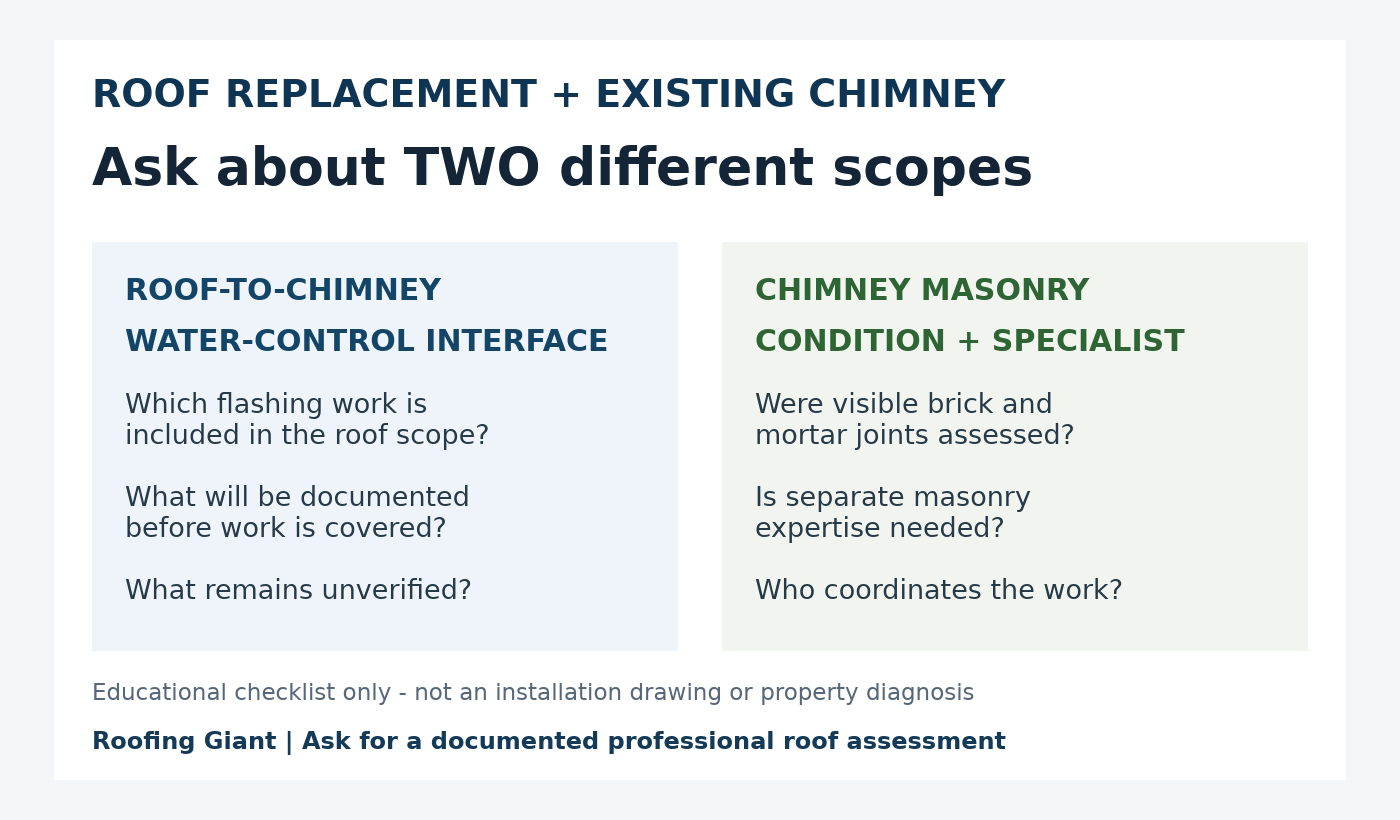
A masonry chimney interrupts the roof surface. When a Dallas–Fort Worth homeowner plans an asphalt-shingle roof replacement, it is worth asking two separate questions: how will the roof-to-chimney connection manage rain, and is the chimney masonry itself in suitable condition? Those questions belong in the project conversation before work begins, even when no leak is visible.
This guide is a planning checklist, not an assessment of any property. A roofer and, when needed, an appropriately qualified masonry professional must evaluate the actual construction and condition.
Why the chimney deserves its own scope discussion
Most of a sloped roof sheds rain across continuous covering. At a chimney, roofing materials meet a vertical structure, creating a transition that needs its own water-control details. The U.S. Department of Energy’s Building Science Education resource explains the role of the roof-to-chimney waterproofing connection and identifies flashing at that intersection. A sound-looking field of shingles cannot, by itself, establish that the transition is performing correctly.
The National Roofing Contractors Association’s Professional Roofing publication also explains why counterflashing matters at masonry walls. Counterflashing helps protect the underlying flashing from rainwater getting behind it. The specific arrangement depends on the chimney and the selected roof assembly. You do not need to prescribe the detail yourself; you need to know who will assess, document and complete it.
Two related assessments, not one vague line item
1. The roof-to-chimney interface
Ask the roofing contractor to explain which roof covering, underlayment and flashing work will be addressed where the roof meets the chimney. In a typical asphalt-shingle and brick-masonry example, the DOE describes base flashing, step flashing and counterflashing as parts of the rainwater-control transition. Those terms describe functions, not a do-it-yourself installation sequence.
For your written proposal, ask what will be removed or replaced, which existing conditions can be evaluated before the roof is opened, and what documentation will be provided before new materials conceal the work. A general statement that the contractor will “handle flashing” leaves too much room for different expectations.
2. The chimney masonry
Brick, mortar joints and the chimney wall above the roof are a different assessment area from the shingles. Professional Roofing notes that open mortar joints or deteriorated masonry above counterflashing can allow rainwater into the masonry even where the counterflashing itself has been considered. It discusses masonry restoration in connection with flashing work.
That does not mean every chimney needs masonry repairs during reroofing. It means an observed concern should be recorded and directed to a professional qualified for the relevant masonry work. Do not assume that a roofing quotation includes chimney rebuilding, repointing or other masonry services unless those services are expressly described.
Six questions to put in writing before approving the reroof
- What was actually observed? Request photographs or a written description identifying the chimney location and visible concerns. Ask the inspector to distinguish observations from possible explanations.
- Which roof-interface components are in scope? Have the roofer identify the proposed roof-to-chimney flashing work and the extent of related roofing work, rather than referring only to “the area around the chimney.”
- Has the visible chimney masonry been assessed? If joints, brickwork or other visible masonry raise questions, ask whether a qualified masonry specialist should evaluate them separately.
- Who coordinates the handoff? If both roofing and masonry work may be needed, agree who communicates the findings and how the work is sequenced. Do not presume one trade is authorized to perform the other’s scope.
- How will unexpected conditions be handled? Ask how concealed or newly visible conditions will be documented, who may propose changes and how you will approve a revised written scope before additional work.
- What records will I receive? Request photographs of relevant completed work, a record of any unresolved limitations, and the final written scope or change approvals.
What a stain near a chimney does—and does not—tell you
A ceiling or wall stain may justify an inspection, but its location does not prove the exact entry point or whether the roof covering, the flashing, the masonry or another condition caused it. Do not diagnose the problem from a photograph, from a weather report or from the fact that the stain is near a chimney. Keep a dated record of what you can safely observe indoors, without entering unsafe spaces.
IBHS’s FORTIFIED homeowner maintenance guidance identifies flashing, chimneys and other roof penetrations as areas that warrant professional attention when concerns arise. It also lists interior water marks among observations worth reporting. Those recommendations support investigation; they do not establish a particular home’s condition.
What to do before the contractor arrives
Collect the existing roofing proposal, earlier repair paperwork if available, and any dated interior observations. Write down where you have noticed a change and when you first saw it. From safe ground-level or indoor locations, you may document visible conditions without reaching onto the roof, using a ladder or touching loose masonry. Leave rooftop photography and close technical assessment to properly equipped professionals.
If the house has a framed chimney chase, thin brick veneer, or a different roof assembly, tell the inspector. The references below describe particular construction contexts and do not supply one universal detail for every home. Also ask the contractor to identify what remains unverified until work begins.
A practical decision before scheduling
It may be entirely reasonable for the roof work to proceed with a clearly defined chimney-interface scope. It may instead be sensible to coordinate a separate masonry assessment first. The useful decision is not “every chimney needs rebuilding” or “new shingles solve any leak.” It is whether the available evidence, specialist responsibilities and written scope address the actual property.
For related project documentation, see Roofing Giant’s roof installation checklist and its roof replacement overview. Those general pages do not replace a chimney-specific assessment.
Next step: Request a Free Roof Inspection from Roofing Giant for your Dallas–Fort Worth home. Ask that visible chimney-to-roof conditions and any need for separate masonry evaluation be addressed in the inspection conversation. If online scheduling is unavailable, use the request form or call the number shown on that page.
Original sources and review dates
- U.S. Department of Energy, Building Science Education — Waterproofing Chimneys. Publication date not displayed; checked November 6, 2026. General water-control principles for roof-to-masonry chimney connections.
- National Roofing Contractors Association, Professional Roofing — Anatomy of a Regleted Counterflashing. November 2022; checked November 6, 2026. Technical discussion of masonry counterflashing and masonry condition, not a specification for this property.
- Insurance Institute for Business & Home Safety, FORTIFIED — Extend the Life of Your Roof. December 3, 2021; checked November 6, 2026. General homeowner maintenance observations and professional-assessment context.
Educational information only. This is not a diagnosis of any chimney or roof and does not provide installation, code, insurance, pricing, masonry-service or warranty advice. Actual findings and responsibilities require a property-specific professional assessment.