Already have solar panels on your Dallas–Fort Worth home, but concerned that the roof may need replacement? There are two separate decisions to make: what the roof needs, and how a qualified solar professional will protect, remove where necessary, and return the photovoltaic (PV) system. The clearest next step is not to schedule both crews independently. It is to ask for a written plan that connects their work.
The U.S. Department of Energy notes that a roof replacement can require removal of the solar panels and mounting system to complete roofing work. The National Roofing Contractors Association (NRCA) explains why a roofing professional and qualified electrical/PV expertise both matter to roof-system compatibility and solar work. Neither source evaluates your particular home; an on-site assessment is still needed.
1. First confirm the roofing decision
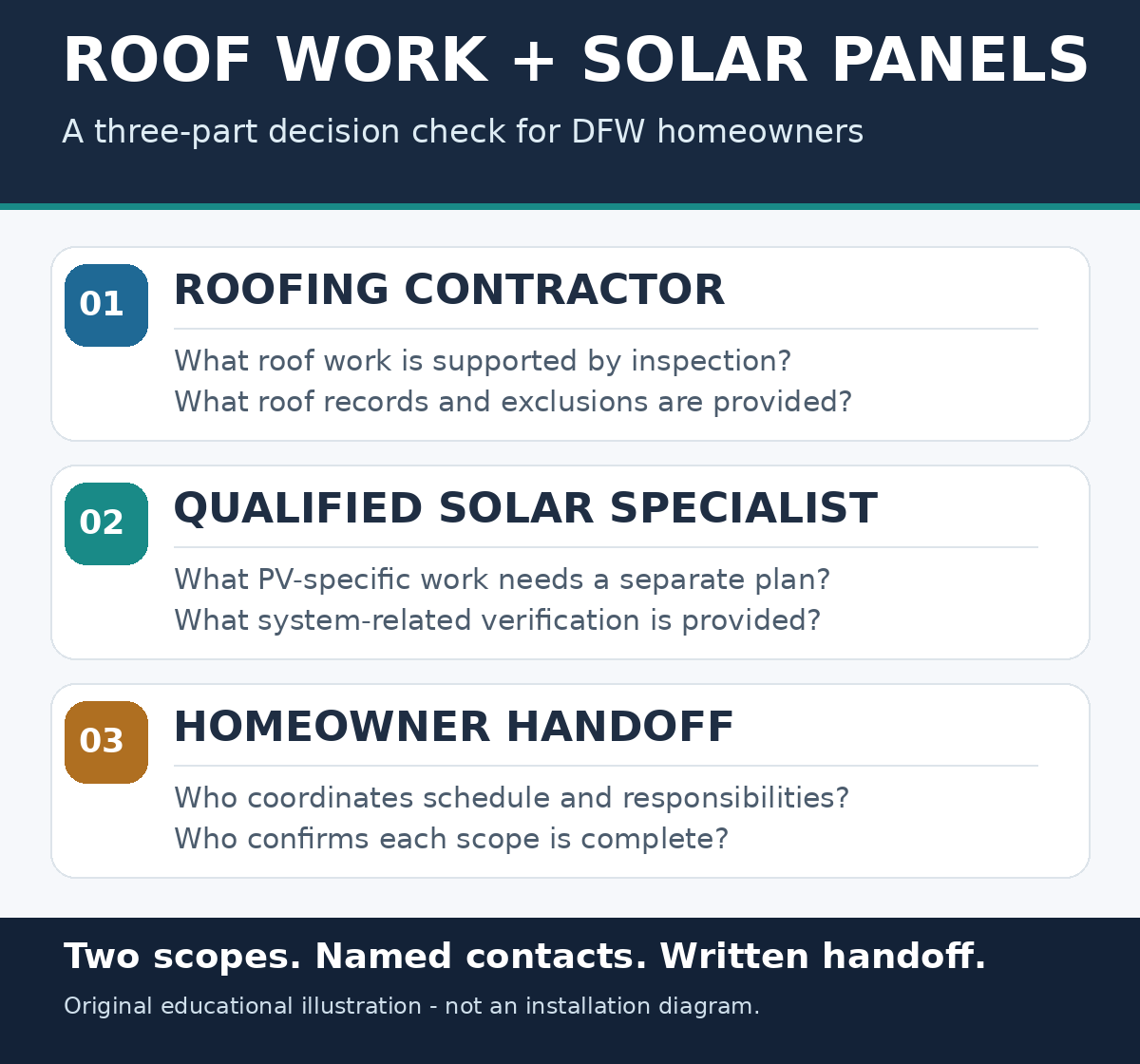
Ask your roofing contractor: What observed conditions support repair, replacement, or further investigation? Request photographs, an explanation of which roof areas are affected, and a proposed roofing scope. A ceiling stain or a solar array’s age alone does not establish that the entire roof must be replaced. If the condition is uncertain, ask what additional professional assessment would resolve it.
Also ask how the existing array affects access for evaluating roof covering, flashing, and areas concealed by panels. The answer may depend on the roof layout and the solar system. Do not assume every roof problem requires removing the entire array, or that the work can be completed safely without a solar specialist.
2. Identify the two teams—and who is responsible for what
Before selecting dates, request the name and contact information of the roofing point of contact and the qualified solar-system point of contact. Ask each to document its own scope. A roofing proposal should describe the roof work; the solar provider should evaluate the PV equipment and determine the appropriate equipment handling and electrical procedures. Do not assume your roofing contractor provides solar removal, electrical disconnection, storage, recommissioning, or solar warranty service unless those responsibilities are specifically confirmed.
NRCA’s March 2025 technical discussion emphasizes that rooftop PV requires roofing knowledge alongside appropriately qualified electrical expertise. A roof contractor understands the covering and weatherproofing concerns; the solar professional addresses PV equipment and associated electrical work. Have the providers resolve any interface questions between them rather than relying on a verbal understanding.
3. Ask for one written sequence before work begins
The simplest planning question is: What must be completed and documented before the next crew starts? Ask both providers to agree on a written sequence covering the initial condition record, any necessary PV-system work, the roofing phase, the next solar phase, and the final handoff. The actual sequence and scope should be determined by the qualified contractors for your property.
Questions worth putting in writing include:
- Who will record the condition of the existing roof and solar equipment before any work?
- Which provider will coordinate schedule changes, property access, equipment handling and weather-related delays?
- What roof areas and roof-system details will the roofing contractor document before the solar equipment is returned?
- Who evaluates the condition and suitability of the existing PV equipment for reinstallation?
- What written confirmation will each provider give when its portion of the work is complete?
This is a coordination checklist, not a do-it-yourself removal or installation procedure.
4. Discuss the roof–solar interface, not just the calendar
Solar equipment is connected to the roof system at specific locations. Ask the roofer how the planned roofing materials and weatherproofing details will be coordinated with the solar professional’s proposed system. Ask the PV professional whether the existing equipment, its documentation, and any proposed changes need separate evaluation. If the providers disagree about who is responsible for an interface detail, resolve that before work begins.
Do not rely on a general promise that the roof or array will perform a certain way. Request a description of what each professional will inspect, document and confirm. Any product-specific requirements or warranty implications belong in a separate review of the applicable actual documents, not in a generic assumption.
5. Plan for DFW access and weather uncertainty
In the Dallas–Fort Worth area, discuss where contractors may safely access the property, how driveways and ordinary outdoor areas will be managed, and who communicates changes if conditions interrupt the schedule. These are planning questions, not a forecast of a storm or a claim about a particular roof. Ask what happens if the roof is found to need a different scope after assessment or work begins, and how both providers will approve the revised plan.
Keep communications in one thread or project record where possible. A dated summary of each team’s responsibilities makes the handoff easier to review if schedules change.
6. What should you receive at the end?
Ask the roofer for the agreed roof-work completion documentation and photographs. Ask the qualified solar provider for its own completion and system-status documentation. Confirm how any unresolved observations will be communicated, who remains responsible for follow-up, and where records will be kept. A solar installation’s operating status is not something to infer from an attractive finished roof photo.
Homeowner safety: Stay off the roof, do not handle solar wiring or mounted equipment, and keep clear of damaged materials or electrical hazards. Qualified professionals should evaluate and perform rooftop and electrical work.
A concise starting checklist
Before committing to a combined schedule, make sure you can answer three questions: What roof work is supported by an assessment? Who is responsible for the existing PV system? What documented handoff connects the two teams? If any answer is unclear, request clarification before approving the scope.
For a roof condition review in Dallas–Fort Worth, schedule a free Roofing Giant roof inspection. Explain that your home already has rooftop solar panels, so the roofing assessment can be coordinated with your own qualified PV professional. Roofing Giant’s roofing inspection is not a promise to perform solar or electrical services.
References
Original publisher sources, checked November 2, 2026:
- U.S. Department of Energy — “Should I Replace my Rooftop Solar System?” (June 25, 2024). In its roof-replacement discussion, DOE explains why an existing solar installation may need to be moved to complete roofing work.
- National Roofing Contractors Association, Professional Roofing — “Something to think about” (March 2025). Discusses the coordination of roofing and PV technical expertise.
Educational information only. Property conditions and professional scopes vary; have a qualified roofer and solar professional assess your situation.