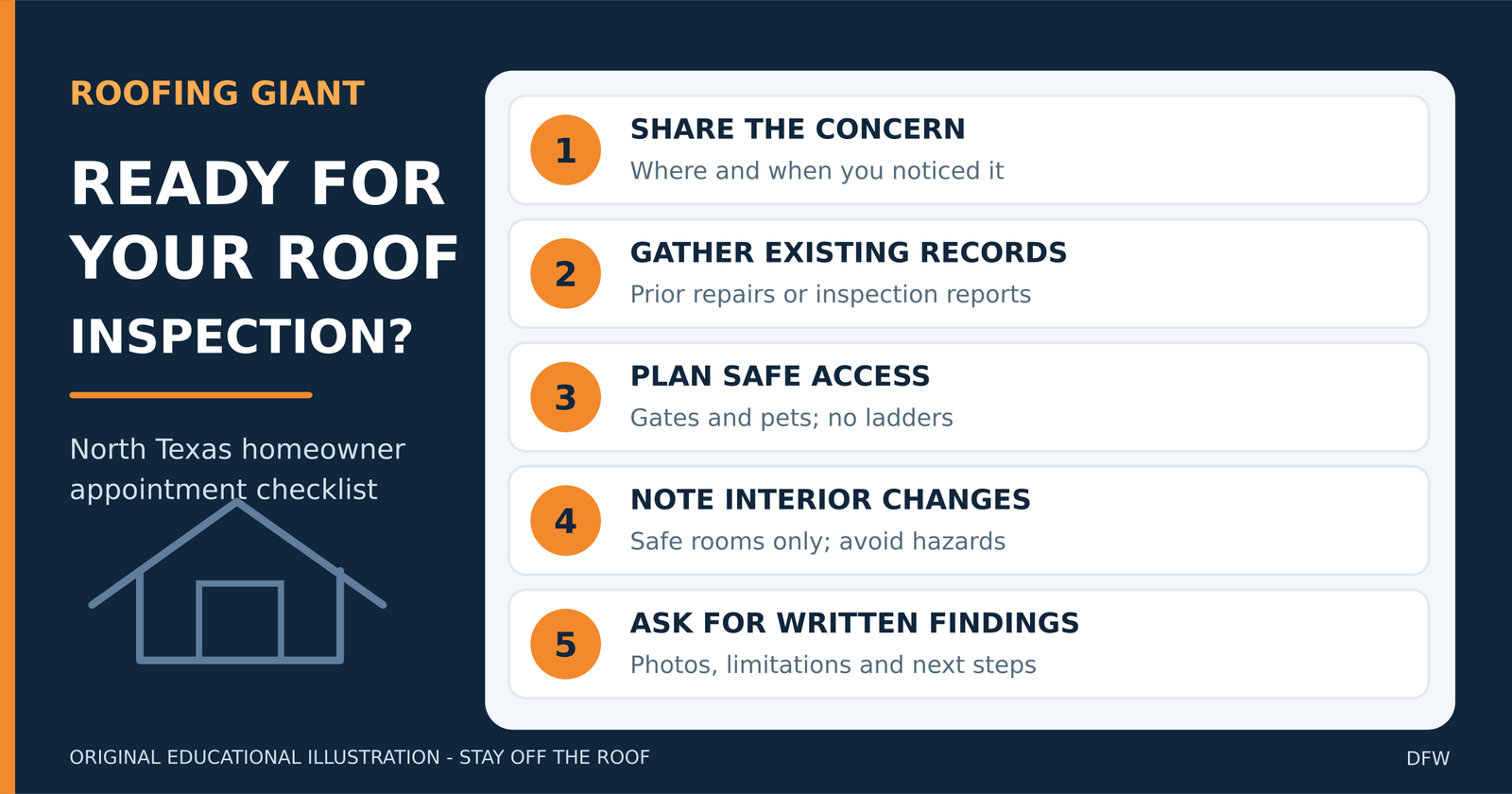
Getting ready for a professional roof inspection in Dallas–Fort Worth should not involve climbing a ladder or trying to diagnose roof damage yourself. The most useful preparation is simpler: tell the inspector what prompted the visit, make safe access possible, and know what questions you want answered. This checklist focuses on preparing for the appointment, rather than repeating a post-storm damage photo guide.
1. Write down your reason for requesting an inspection
Before the visit, make a short list of your concerns in everyday language. For example: “I noticed a stain above the upstairs hallway,” “one downspout seems loose,” or “I want to understand the roof condition before planning maintenance.” Note when you first noticed each item. If you do not know the cause, say so. A ceiling stain, for instance, is an observation—not proof of where water entered.
Prioritize your top two or three questions so they do not get lost during the appointment. A useful goal is to leave knowing which concerns were evaluated, which areas were inaccessible, and what next steps are recommended.
2. Collect useful records, but keep private information private
If available, gather the approximate roof installation year, past repair invoices, a prior inspection report, and any photographs that show a change over time. You do not need perfect records for an inspection to be worthwhile. Simply flag what you have and what you are unsure about.
Share relevant documents directly with the company or inspector through an appropriate channel. Do not post your address, private contract documents, or interior photos containing personal information in public comments. If you rent the property or manage it for someone else, establish who can authorize access and receive the findings before the appointment.
3. Plan ground-level access without creating new hazards
Confirm the appointment contact number and a practical arrival location. If there is a gate, explain how the inspector can reach the exterior areas they are permitted to assess. Secure pets away from the work area; move vehicles only if doing so is convenient and safe. Mention any locked sections, fragile landscaping, accessible electrical hazards, construction activity, or areas where an inspector may need the owner’s permission.
Do not put up a ladder or climb onto the roof to make access easier. Do not remove roof debris, disturb suspected damaged materials, or enter an unstable building. The National Weather Service advises staying away from downed power lines and using caution around storm debris after high winds. If hazards remain, tell the inspector before anyone approaches and contact the appropriate emergency or utility service for urgent danger.
Roof access and timing are decisions for the professional on site. Wet surfaces, wind, lightning, unsafe structural conditions, or other hazards may mean an area cannot be inspected that day. A postponed or limited inspection is preferable to unsafe access.
4. Make a safe interior observation list
If the concern involves a room that is safe to enter, record the location of a stain or visible dampness, whether it looks new or has changed, and the date you observed it. A wide photo of the room and a closer image can help the inspector locate the concern; take them only from a secure floor position. You do not need to open a ceiling, enter an unsafe attic, or move insulation.
Keep away from water near electrical fixtures or equipment, sagging ceilings, and rooms with apparent structural damage. Report those hazards when booking. An inspector may want to discuss the interior location before looking at the corresponding roof area, but an interior mark alone does not establish the source.
5. Understand what the roof inspector may examine
A professional inspection may evaluate visible roof-covering conditions and related details such as roof edges, flashing, roof penetrations, drainage, and accessible interior signs. What can be checked depends on the property and safe access. The Texas Department of Insurance recommends checking for missing or damaged shingles after storms and periodic professional roof inspections as part of roof maintenance.
Ask whether the inspector can document both overall roof areas and any specific concerns with photographs and written observations. A good discussion distinguishes a visible condition from its possible cause, and a recommendation from a conclusion that requires further investigation. It should also make clear which areas were not inspected.
6. Ask these questions while the findings are fresh
- What did you actually observe? Ask for locations and photos, not a diagnosis based only on a distant appearance.
- What could not be assessed safely? Inaccessible areas should be named rather than silently assumed to be sound.
- Which concerns need prompt attention? Ask the inspector to distinguish immediate safety or water-entry concerns from routine maintenance.
- What options make sense? Depending on the observations, the answer might be monitoring, maintenance, targeted repair, further evaluation, or replacement—not necessarily a new roof.
- What will I receive afterward? Confirm how the inspection findings and any proposed next steps will be provided.
There is no need to make a repair decision while standing in the driveway. Request a clear explanation of the observed conditions, the limitations of the inspection, and the reasoning behind any recommendation.
7. Keep the appointment record useful afterward
Save the inspection date, inspector contact information, the written findings, and any relevant photographs together. Mark unresolved questions for follow-up. If different people are involved in a property decision, share the same factual report so everyone starts from the same observations. Avoid changing photo files in ways that could obscure what they originally showed.
For a related but different question—what should the inspector’s report contain?—see our guide to roof inspection documentation. If you are deciding whether to request an inspection after bad weather, use our post-storm inspection guide.
Prepare for an inspection with Roofing Giant
Roofing Giant serves the Dallas–Fort Worth area. If you have a roof condition question and want a professional assessment, request a free roof inspection. Describe your top concerns and any access or safety limitations when contacting the team. If online scheduling is temporarily unavailable, use the contact options provided on that page.
Original sources and verification
- National Weather Service — After a High Wind Event: downed power-line and debris precautions. No publication/update date stated on the page.
- Texas Department of Insurance — Insurance and Your Roof: maintenance checklist and professional inspection guidance; last updated April 1, 2026.
Original sources checked October 23, 2026. General educational information only. Property conditions vary. Have a qualified roofing professional assess suspected roof damage; do not enter unsafe areas to document a concern.